EDIXONMAGLEV CAR
The Maglev Space Car is designed to operate based on Lenz's Law Levitation, utilizing short-circuited honeycomb aluminum coils. These coils serve dual purposes: facilitating levitation and generating electricity by harnessing the kinetic energy of the moving Maglev cars. This innovative concept is particularly suited for theme parks, smart cities, or Maglev race circuits. The Maglev Car is invented by a Filipino Don Jose Luga Guardo Jr. from Cantilan, Surigao del Sur under USPTO No. 7059252 B2.
Anewparadigmofmovement.
MaglevVisionismorethantransportation.Itistheembodimentofhumanity'snextevolutionarystep—frictionless,silent,anddeeplyconnectedtotheplanetwesteward.Wearebuildingsystemsthatdon'tjustmovepeople,butelevateconsciousness,economies,andtheverywaywerelatetodistance.
Technologythatfeelslikemagic.
Built on decades of magnetic innovation and next-generation intelligence.
3D Guardo Monopolar Halbach Array
Next-generation 3D magnetic field architecture delivering superior lift efficiency, stability, and energy regeneration compared to traditional Halbach arrays.
Aether Intelligence Core
Onboard edge AI with holographic interface. Real-time environmental awareness, predictive routing, and seamless voice + biometric command integration.
Zero-Contact Infrastructure
Cable-free, trackless operation using dynamic magnetic coupling. Minimal environmental footprint with full energy recapture on descent and braking.
Feelthefutureinmotion.
MAGLEVFLOW
TheMulti-CarCyclicMagneticElevator—redefiningverticalmobilitywithseamlesscyclicflow,regenerativeenergy,andcable-freemagneticprecision.
Wheremagnetismcreatescontinuousverticalflow.
Maglev Flow is the patented Multi-Car Cyclic Magnetic Elevator system that reimagines vertical transportation as a fluid, regenerative, high-capacity experience — using Guardo Monopolar Arrays, cyclic shaft architecture, and gravity-linear energy recovery.
+ Regenerative Gravity
- Cable-free operation✓
- Multiple cars per shaft✓
- Energy regeneration✓
- Continuous cyclic flow✓
HowMaglevFlowworks.
A closed-loop magnetic system engineered for maximum shaft utilization and energy intelligence.
Magnetic Levitation
Guardo Monopolar Arrays deliver stable, frictionless levitation along precision guideways in the shaft corners.
Cyclic Multi-Car Architecture
Multiple cars operate at once across mono-directional shafts linked by intelligent transition bays — a continuous vertical loop.
Magnetic Propulsion
Passive magnetic rotary propulsion wheels engage with tracks for smooth, efficient, highly controllable motion.
Regenerative Gravity Generation
Linear gravity generators recover energy during descent — turning gravity into a resource, not a burden.
Transformativeadvantagesforthebuildingsoftomorrow.
Higher Capacity
Multiple independently controlled cars share the same shaft. Up to 3–5× traditional throughput.
Regenerative & Sustainable
Gravity linear generators convert descending motion into electricity. Energy intelligence at the core.
Cable-Free Reliability
No ropes to fray or replace. Non-contact magnetic systems lower maintenance and raise safety margins.
Smooth, Precise & Fast
Magnetic levitation delivers a near-silent ride with minimal vibration and exceptional positioning accuracy.
Optimized Building Space
Better shaft utilization reclaims floor area — enabling taller, leaner cores without compromise.
Future-Ready & Scalable
Engineered for supertalls, airports, and vertical cities — foundational for sustainable urban verticality.
ProudlyadvancingFilipinoinnovationinverticalmobility.
Invented by Jose Luga Guardo Jr., the patented Multi-Car Cyclic Magnetic Elevator with Gravity Linear Electric Generator is a fundamental rethinking of how people and energy move through vertical space.
The Future ofCity Transit.Now Levitating.
IntroducingtheMaglevMonorial—agroundbreakinggravity-assisted,Lenz'sLawlevitatedtransportationsystemdesignedtoreplaceagingmetronetworksindensecitycenters.
Traditionalmetrosarereachingtheirlimits.It'stimeforsomethingfundamentallybetter.
Wheel-based systems create noise, vibration, high maintenance, and energy waste. The Maglev Monorial eliminates mechanical contact entirely while dramatically simplifying infrastructure through intelligent use of physics.
Physics-FirstTransportation.
The Maglev Monorial leverages two elegant physical principles to deliver superior urban mobility:
A passive, ultra-efficient guideway with all active propulsion concentrated at stations — drastically reducing infrastructure cost while delivering a silent, smooth ride suited to dense city centers.
HowtheMaglevMonorialWorks.
Station Maglev Sling
All propulsion and acceleration happens exclusively at stations. Powerful electromagnetic linear motors act like a sling, launching the train smoothly to cruising speed. No propulsion infrastructure needed along the entire guideway.
Lenz's Law Levitation
As the vehicle moves, its magnetic arrays induce powerful eddy currents in the guideway. These currents generate an opposing magnetic field (Lenz's Law), lifting the train into stable levitation with minimal ongoing energy.
Gravity Glide Between Stations
Once at speed, the train coasts using a carefully engineered combination of momentum and subtle gravity assist from the guideway profile. Deceleration and re-acceleration occur only at the next station's Maglev Sling.
Silent.Spacious.Effortlesslysmooth.
TransformativeBenefitsforUrbanCenters.
Gravity glide + efficient Lenz levitation + propulsion limited to stations dramatically reduces overall power consumption compared to conventional metro systems.
No wheels, no rails to grind, no mechanical drive systems along the guideway. The long infrastructure is passive and extremely durable.
Perfect for dense city centers and mixed-use neighborhoods. Minimal noise and zero vibration transmitted to surrounding buildings.
80 km/h top speed is optimal for city-center distances and stop frequency. Elevated or at-grade adaptable design minimizes disruption during construction.
Stable passive levitation, redundant systems, and station-centric propulsion create a highly predictable and fault-tolerant operating environment.
Simplified guideway (propulsion only at stations), lower energy, and reduced maintenance translate into significantly better economics for transit authorities.
BuiltonProven,PatentedInnovation.
The Maglev Monorial is grounded in the pioneering Magnetic Levitation Transportation System work of Filipino inventor Jose Luga Guardo Jr. (also known as Don Jose Luga Guardo Jr.).
His WIPO-patented technologies in magnetic levitation, gravity-assisted linear electric systems, and advanced magnetic arrays provide the foundational science for this next-generation urban application.

R³PR
REUSABLE RETRACTABLE
PROPELLER ROCKET
GuardoReusableRetractablePropellerwithColdEngineLinearCompressorforactivefuelregeneration.Hypersoniclogisticsatthespeedofneed—maglevcatapultlaunch,plasmabooster,solar-supercapacitorhybrid.
Sixbreakthroughtechnologiesworkinginharmony.
Retractable Propeller System
Four carbon-composite, variable-pitch propeller blades that fully retract into the nose fairing for hypersonic flight and extend for precision VTOL landing.
Compressed Air Plasma Booster
Electrothermal / MPD plasma rocket using compressed air as primary reaction mass. High specific impulse, deep throttling, rapid restart.
Solar Panel Fuselage
Structural thin-film multi-junction solar cells embedded into the carbon fiber skin. Continuous power for avionics and supercapacitor trickle charging.
Supercapacitor Rim Array
High-density supercapacitor modules circumferentially on the mid-body. Megawatt peak power for plasma acceleration and maglev interface.
3D-Printed Carbon Fiber Airframe
Large-format additive monocoque using aerospace-grade CFRP. Optimized lattice cores, embedded sensors, mission-specific variants.
Maglev Catapult Interface
Linear synchronous motor interface pads along the fuselage. High-acceleration vertical launch assist from specialized high-rise shafts.
High-RiseMaglevCatapultTowers
Purpose-built 350–500 meter towers featuring a central launch shaft lined with segmented linear maglev arrays. The rocket is accelerated electromagnetically to high subsonic / low supersonic velocities before plasma booster ignition.
Specialized 300–500 m high-rise buildings with integrated linear maglev arrays serve as vertical launch catapults. Designed for rapid payload integration, high-frequency operations, and vertical landing via the retractable propeller system.
End-to-EndLaunch&RecoverySequence
Payload Integration & Pre-Flight
Hypersonic cargo loaded into pressurized bay. Systems checkout, supercapacitor pre-charge, propellers stowed.
Maglev Catapult Acceleration
Linear maglev array accelerates the rocket up the shaft to 700–900 km/h exit velocity.
Plasma Booster Ignition & Ascent
Compressed air plasma rocket ignites at shaft exit. Hypersonic cruise or suborbital trajectory.
Hypersonic Cruise & Precision Recovery
Plasma throttles down at destination, propellers deploy for VTOL landing. Rapid turnaround.
TechnicalSpecifications
| Parameter | Value | Notes |
|---|---|---|
| Overall Length | 28.4 m | Including nose fairing & nozzle |
| Body Diameter | 3.8 m | Optimized for maglev shaft clearance |
| Launch Mass (wet) | 84,500 kg | Including 4,500 kg payload |
| Hypersonic Payload | 4,500 – 6,200 kg | Interstate / Intercontinental |
| Max Cruise Speed | Mach 8.2 | Sustained with plasma assist |
| Plasma Booster Thrust | 1.15 – 1.35 MN | Throttle range 15–105% |
| Supercapacitor Peak Power | 120 MW | 3-second burst capability |
| Solar Array Output | 45 kW peak | Structural fuselage integration |
| Maglev Exit Velocity | 720 – 920 km/h | Dependent on shaft length & power |
| Target Reusability | 150+ cycles | 5-year design service life |
Sustainable.Rapid.TrulyReusable.
IntelligencethatlivesintheAether
Aether Indexed Inferenced Intelligence — Ai³
Powered by the TESHA Photonic AI Chip
ThisisnotArtificialIntelligence
Conventional AI
Centralized, power-hungry, hallucinates, controlled by distant corporations, runs in the cloud.
Ai³ — Aether Indexed Inferenced Intelligence
Ambient, sovereign, grounded in verified knowledge, reasons with depth, runs at the edge on light.
THE Ai³ DIFFERENCE
- ●Indexed — draws from structured, verifiable local & community knowledge
- ●Inferenced — multi-step causal reasoning, not just pattern prediction
- ●Aether — lives in the pervasive photonic mesh, close to people
TESHA Photonic AI Chip
Intelligence that computes at the speed of light.
- • 10–100× more energy efficient than electronic GPUs
- • Near-zero heat — perfect for edge & off-grid
- • WDM parallelism for simultaneous multi-agent reasoning
- • Sovereign hardware you can own and trust
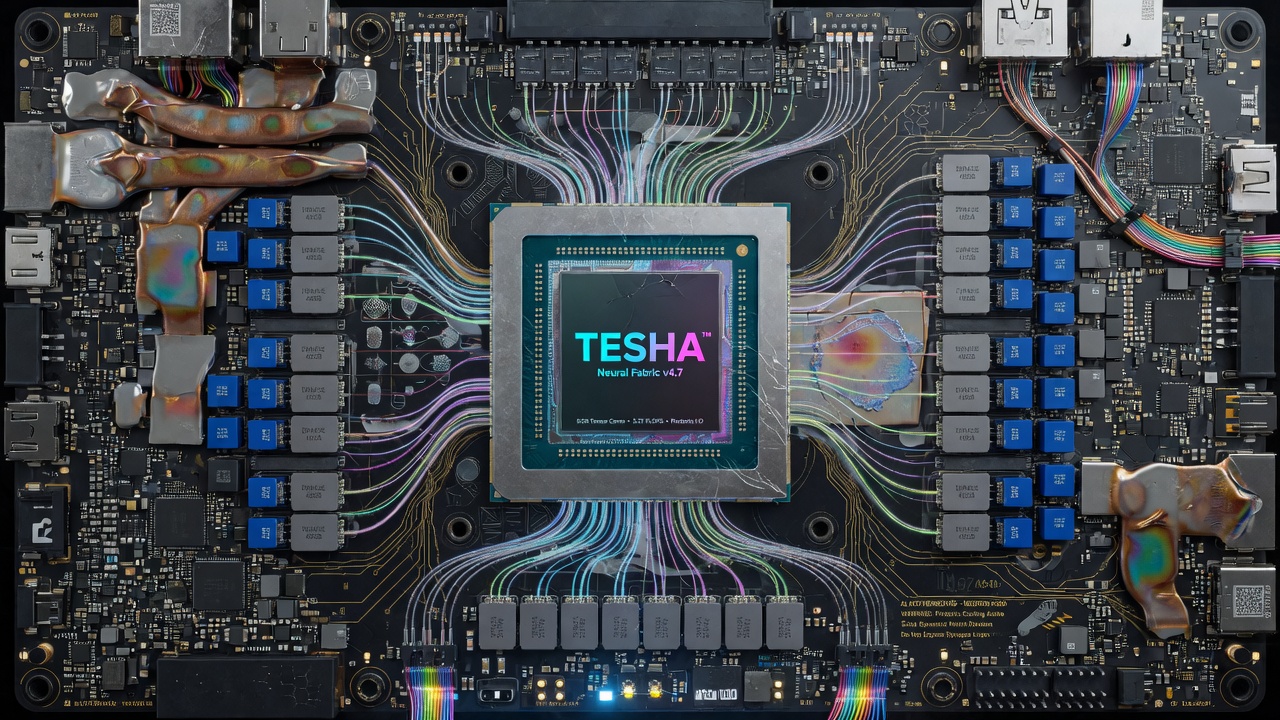
Light itself becomes the medium of thought.
HowAi³Works
Three pillars. One living intelligence.
Aether
Pervasive photonic mesh. Intelligence flows through light across sovereign nodes.
Indexed
Structured, verifiable knowledge. No hallucinations — only grounded truth.
Inferenced
Deep causal reasoning. Plans, reflects, and thinks with you.
Theintelligenceweactuallyneedishere.
Ai³ on TESHA Photonic Chip — built for communities, not corporations.
CANTILAN • PHILIPPINES • NEW EARTH SYSTEMS
Readytohelpbuildthefuture?
We're looking for visionary engineers, designers, investors, and city partners who believe movement should be beautiful, silent, and regenerative.